
 By Marrio Phill
Perhaps you have heard that the front door is one of the more common entry points for burglars. You have decided that you need some video surveillance. But now you are wondering whether you should invest in a Wi-Fi camera or a video doorbell. Is one better than the other for front door surveillance?
Both Wi-Fi cameras and video doorbells make it possible to monitor the front door. But how they go about it is different. As such, both have their strengths and weaknesses. Deciding the best option in your case depends a lot on your circumstances and needs. There is no one-size-fits-all solution for every scenario.
The Wi-Fi Camera
The Wi-Fi camera is simple enough to understand. It is a wireless camera that connects to your security system over your home network. And if you do not have a home security system, it connects to its manufactured cloud environment over the internet.
One advantage of the Wi-Fi camera is that it offers a wider field of vision. Depending on where you place it, you can get a view that goes far beyond just the front door. You might also see the entire front yard, your driveway, a portion of the street in front of your home, and even small portions of your neighbors’ properties.
More advanced Wi-Fi cameras offer features like night vision, remote panning and tilting, custom zones, and even the ability to discern between people, pets, and vehicles.
The Video Doorbell
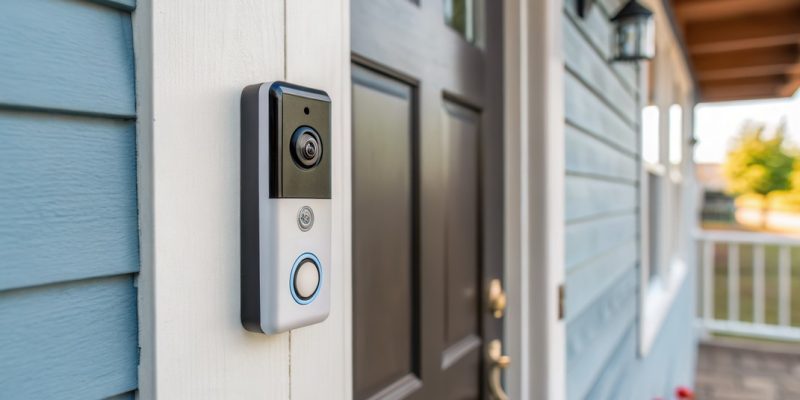
The video doorbell combines the traditional doorbell paradigm with real-time video surveillance. You get a single unit with both a doorbell chime and a video camera. Most modern video doorbells also feature onboard audio that allows communication between homeowner and guest.
In terms of view, a typical video doorbell gives you a clear view of the area right in front of the door, as well as the walkway and a portion of the yard. But unless your front door is fully exposed – with no porch, overhang, carport, etc. – you are not likely to see the entire yard and the street.
On the other hand, high-end video doorbells come with their own advanced features. Think of things like motion detection, night vision, and facial recognition. Some video doorbells can be integrated with smart locks so that a positive facial identification automatically unlocks the door as a family member approaches.
Key Considerations When Choosing
With a basic understanding of Wi-Fi cameras and video doorbells, it is time to talk about making a choice. What should a home order consider? What factors will influence the decision?
Vivint Home Security is one of the nation’s leading home security providers. Their systems support both Wi-Fi cameras and video doorbells. Here are the key things they recommend thinking about:
1. Property Ownership
Who owns the property and how the property is used form the foundation of the decision-making process. There are three possibilities to consider:
- Homeowner – A homeowner has the right to do with their property as they please. They can opt for a video doorbell, a Wi-Fi camera, or both. Note that this applies to the homeowner living on the property themself.
- Renter – A renter is considerably more restricted. Leases tend to contain language preventing renters from making any substantial changes to a home or apartment. Lease language could limit a renter’s options for video surveillance.
- Landlord – A landlord operating either long- or short-term rentals is also somewhat restricted. State law defines what is and is not allowed in terms of both Wi-Fi cameras and video doorbells.
Assuming you are a homeowner with every option available to you, what are the other considerations? Let us move on.
2. Surveillance Goals
Next up are surveillance goals. What do you hope to achieve by surveilling the front door? If your primary concern is stopping package theft, a video doorbell will be just as effective as a Wi-Fi camera. It might even be more so because of its ability to grab a more detailed image of a perpetrator’s face.
A video doorbell also gives you the added advantage of being able to communicate with visitors in real time. If someone you suspect to be a porch pirate is approaching your home, you can speak to that person using the on-board video. That could be enough to scare the perpetrator away.
If you are looking for more comprehensive coverage because you’re worried about burglary or home invasion, a Wi-Fi camera is going to be a better choice. You get a much larger view and, with it, have the potential for earlier warning as visitors approach. A video camera gives you the added benefit of being able to surveil your driveway and car at the same time.
3. Integration Plans
You might also want to consider any plans you have to integrate your video footage with the rest of your home security system. Perhaps you already have a prepackaged system from a provider like Vivint. Everything you purchase from Vivint fully integrates with the entire system.
On the other hand, maybe you have no home security system or you plan to build one piecemeal using a smart home ecosystem like Google Home or Amazon Alexa. Your choices of both Wi-Fi cameras and video doorbells are likely limited based on the ecosystem you choose. Here’s the point: settle on an ecosystem before you start purchasing devices.
4. Your Budget
Last but not least is your budget. You can spend a little or a lot on both Wi-Fi cameras and video doorbells. Perhaps your budget will support all the bells and whistles if you go with a video doorbell instead of a camera. But maybe you would rather spend more on a Wi-Fi camera to get a larger view of your property.
Wi-Fi cameras and video doorbells both bring a lot to the table. The good news is that you get to choose which is best for your circumstances. That is the beauty of home security in the 21st century.